Tear up the org chart for real AI value
The companies winning with AI didn't automate their old processes. They demolished them - and rebuilt the organisation around them.

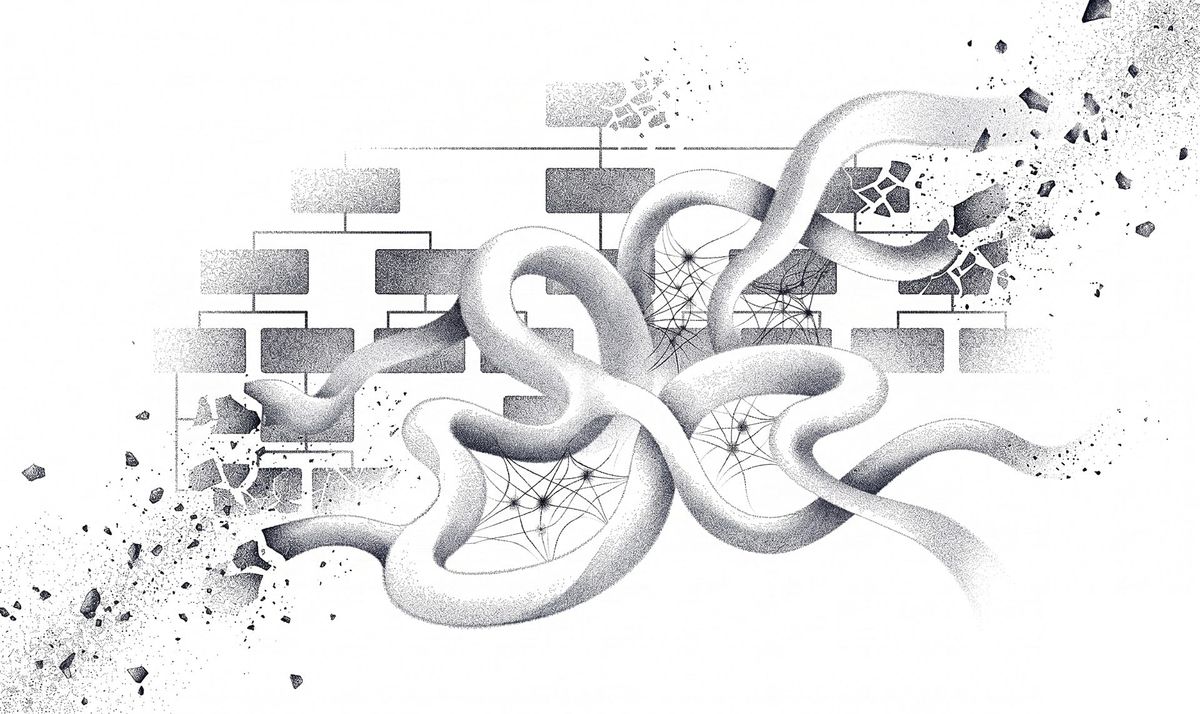
The companies winning with AI didn't automate their old processes. They demolished them — and rebuilt the organisation around them.
I want you to picture a room.
The walls are papered with Post-its. The coffee in the cardboard cups went cold an hour ago. On the whiteboard, in enormous, ambitious letters, someone has written AI TRANSFORMATION. Everyone in the room is extraordinarily busy. There are prioritisation matrices. There are agile sprints. There are fifty, sometimes two hundred, carefully catalogued "use cases."
And six months later, in terms of measurable value, almost nothing has happened. A few people now use ChatGPT to make their emails sound a little more polite. That's the return.
This is not a story about one failed workshop. It's the default outcome of how most organisations are approaching AI right now. And I want to use it to walk through a thought experiment — a composite case, drawn from patterns I keep seeing, built around a single fictional-but-entirely-plausible institution. Call it a large, global, heavily regulated bank. Nothing here describes a specific client. Everything here describes something real.
The bank's projection, communicated internally, is a 35 to 50% reduction in headcount by 2029, with explicit KPIs in every function tied to that target. The number is deliberately uncomfortable. I'm using it because the only way to understand what this kind of transformation requires is to start from a number that forces you to take it seriously.
The bank can credibly project that number for exactly one reason. They stopped trying to fit AI into their organisation. They rebuilt the organisation around AI.
The architecture failure nobody names
Let's start with why the Post-it walls fail, because the reason is more interesting than "the technology wasn't ready."
The two hundred use cases aren't the problem. The problem is that all two hundred are trapped inside departmental structures that feel like they were designed in the 1990s — chained to approval processes, governance gates, and handoffs built for an entirely different kind of work.
From a systems perspective, this is an architecture failure. Organisations are trying to force an exponential, near-instant technology into a structure that was fundamentally designed for what we can call human throughput.
A traditional org chart is, at its core, an elaborate crutch for human limitations.
Think about what hierarchy is actually for. It coordinates human work, because a person can only work eight hours a day. It catches human error, because we get tired and miss things. It divides responsibility, because no single person can know everything. Every box and reporting line on that chart exists to manage the constraints of human beings.
Now take an AI that can analyse thousands of data points in a fraction of a second, and drop it into a process built for human meetings and human approval loops. What happens?
It backs up. At best, you get a tiny incremental improvement — you've made a fundamentally slow, broken process marginally faster.
I think of it as building a ten-lane motorway for the fastest sports cars in the world, and then installing a manual toll booth with a barrier every five hundred metres, where a tired employee has to stamp each ticket by hand. The engine doesn't matter. The road doesn't matter. The booths set the speed.
The bank's breakthrough began when they stopped optimising the toll booths and asked a different question entirely: what outcome are we actually trying to produce — and what does this process look like if AI executes it end to end, completely alone?
The illusion of human control
Ask that question seriously and you immediately hit the most sensitive nerve in any enterprise: the near-religious attachment to keeping a human in the loop.
In nearly every meeting I sit in, the same sentence appears. "The AI can do the draft, that's great — but of course a human has to sign off at the end." It sounds responsible. It sounds like governance. And it is the single most expensive trap in the entire field.
Here's the mechanism, and it matters that you follow it precisely. Whenever a process is designed so a human must verify, edit, or approve an AI's output, the process doesn't speed up. It freezes.
People object: but the AI did the hard analytical work. The human just glances and nods. That takes seconds.
Except "just glancing" doesn't exist in cognitive reality. Picture an AI agent producing a complex credit risk analysis. If a human is going to genuinely verify it — not blindly sign it — they have to reconstruct the entire chain of reasoning in their own head: every data point, every trade-off, from the ground up. Only then can they judge whether it's right.
You haven't saved any time. You've built a brand-new bottleneck and added steps to it.
The bank learned this the hard way. Their first wave of agents worked exactly this way: produce a first-rate output, flag it for mandatory human review, and wait. And wait. The agents existed. Almost nobody used them, because the constant wait for a human rubber stamp made the new process slower and more frustrating than the one it replaced.
At this point, every regulated organisation listening tenses up. We need governance. We're a bank. We can't unleash autonomous AI on customer data with no one watching. Correct. The answer is not to abolish governance and operate in the Wild West. The answer is to move the point of human intervention — strategically, and drastically.
Look at what they did in recruiting.
Previously: humans wrote the job ads, humans screened hundreds of CVs, humans compared candidates in spreadsheets. Slow, inconsistent, error-prone. Now, AI executes the entire first stage at one hundred percent. It generates the job description from the team's needs. It searches internal talent pools and external networks on its own. It screens every application, matches skills, schedules interviews, and conducts the first pre-screening conversations through digital interfaces.
No human assistance in stage one. None. The human enters only at a genuinely meaningful threshold — as the final decision-maker on the shortlist. Not as a bored approver of a pre-filtered list, but as the real decision.
And here's the detail that reportedly silenced the board: feedback from rejected candidates is measurably, significantly better than it ever was under the human-led process.
Sit with that. The people who didn't get the job are more satisfied being screened out by an AI than by a human recruiter.
Once you think about the mechanics, the logic is almost inescapable. A human recruiter is capacity-constrained and stressed. They take weeks to respond — the infamous candidate ghosting everyone hates. They carry unconscious bias. They write vague rejection emails out of fear of legal exposure. And on a bad Friday afternoon, they miss a crucial detail in a CV. A well-designed AI process is the opposite of all of that: consistent, thorough, never leaving anyone hanging for four weeks, replying in minutes, smooth and transparent and fair. The "human touch" we assumed was irreplaceable turns out, in this specific task, to be the weakest link.
Four quadrants, and the one that compounds
The bank organised its thinking around four quadrants.
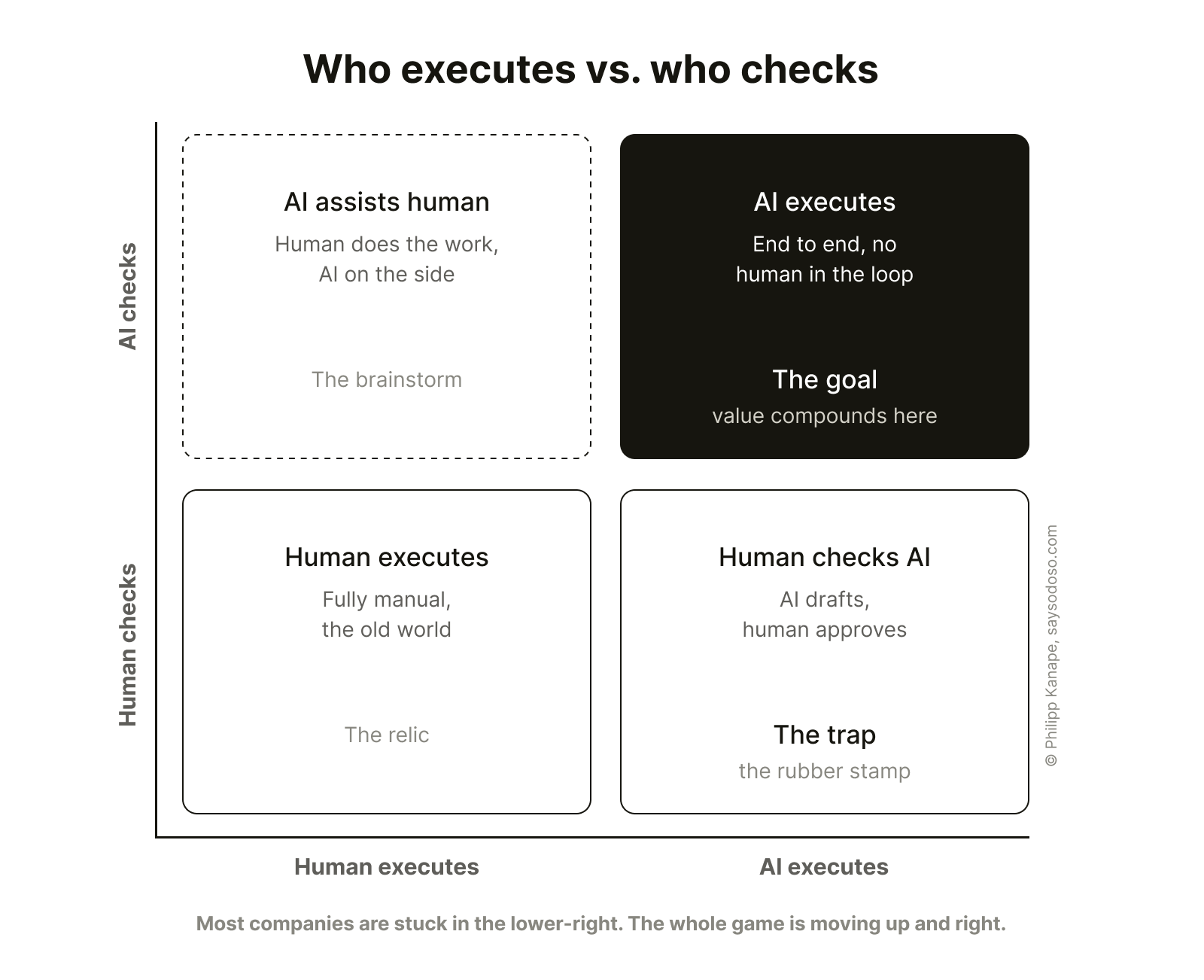
Quadrant one: AI executes autonomously. Quadrant two: AI assists a human — your classic ChatGPT brainstorm. Quadrant three: a human is assisted by AI, where the AI does most of it and you steer. Quadrant four: humans do it manually.
The bitter reality is that almost every company today operates exclusively in the middle two quadrants. AI drafts the text, the human edits it. It feels like enormous progress. The metrics on paper look fine — you're a few percent more efficient. But the exponential return, what economists call compounding value, is never reached.
Why? Because compounding value only gets released when you eliminate an entire category of coordination cost. As long as a human still has to edit the draft, you're still paying that human to send emails back and forth, to schedule meetings, to chase approvals. The coordination cost stays high. Only when AI runs the process from A to Z does that cost disappear — and that disappearance never happens in the middle quadrants. It's like patting yourself on the back in the boardroom for applying band-aids ten percent more efficiently, instead of finally sanding down the sharp edges everyone keeps cutting themselves on.
To be clear: the middle quadrants are not wrong everywhere. There are safety-critical decisions and genuinely unpredictable contexts where AI isn't reliable enough yet, and human judgment is non-negotiable. The discipline is to answer that question honestly — rather than defaulting to the human rubber stamp out of sheer institutional inertia, because it feels politically safer.
So here's the uncomfortable question to take back to your own desk. When you keep a human in a given loop, is it because human judgment there is genuinely indispensable? Or is it because that's simply how your org chart has always done it?
The onboarding wall
Suppose leadership gets it. They want quadrant one. They want to eliminate coordination cost. How does that actually look in practice?
The bank tried, and nearly drove into a wall at full speed.
For six months they attempted to build end-to-end AI inside their traditional structure. With two or three small, isolated teams, it held together. Then came the litmus test: onboarding a new employee.
Onboarding a single new hire stretched across seven separate departments. The HR business partner for the contract. Learning and development for training. Risk management for access rights. The CFO's area. And three separate IT groups provisioning laptops and software licences. Seven departments means, in practice, seven chains of command and seven different priority lists.
So when the CFO suddenly needed their risk expert back for an urgent project, the onboarding simply stopped. The new colleague sat for days without a laptop, because no one felt accountable for the whole.
At this exact point of frustration, almost every company reaches for the same reflex: See? We told you. The AI doesn't really work. It doesn't scale. And that conclusion is completely wrong.
The bank's realisation was different, and deeper. This was never a technology problem. It was an org-chart problem. The AI, through its sheer speed, had simply made it impossible to ignore how dysfunctional the seven-stage structure already was.
Their response was radical: throw traditional departmental thinking in the bin. Stop structuring the organisation around functions like "IT" or "HR," and rebuild it around journeys — the end-to-end processes AI was meant to execute. A recruiting journey. An onboarding journey. An offboarding journey. Each one with a single dedicated, interdisciplinary team, one primary KPI, and complete, undivided ownership of the AI agents serving it. No handoffs. No waiting on IT. Everything inside the one team.
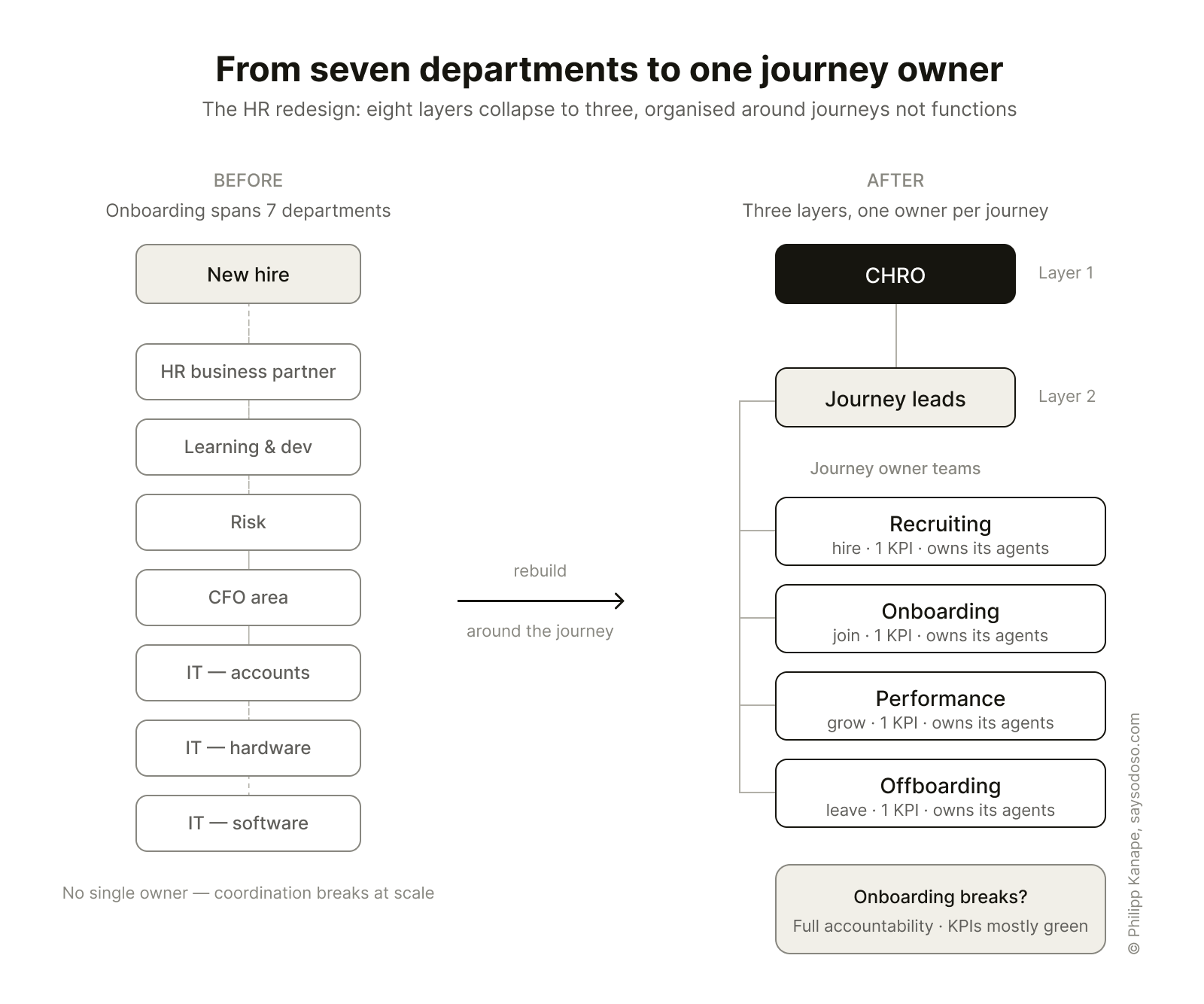
The consequence for hierarchy was brutal. They shaved the organisation from eight layers to three: the CHRO at the top, journey leads beneath, operational teams below that. No division heads, no department heads, no group leads in between.
Internally, employees didn't describe this as a loss. They described it as a huge relief.
Think about why. When onboarding breaks now, you call exactly one phone number: the onboarding journey team. Before, you convened a crisis meeting with seven department heads who spent it assigning blame to each other. A system with one phone number and crystal-clear accountability is steerable. A system with seven departments and endless coordination meetings is not — no matter how clever your AI is.
Why "pilot carefully and scale slowly" is the trap
Now the real question: how do you execute open-heart surgery like this without the business descending into chaos?
The instinct is always the same. We pilot carefully. We prove value small. We manage risk meticulously. Then we scale gently over three years. This is the conventional management wisdom — and it's exactly what has to be demolished.
The bank's early HR pilots were ambitious, including politically radioactive ones like AI-assisted performance management for senior leaders. The technology worked. But the strategic lesson from those successful pilots was devastating to management: they could program AI inside the old structure, but the old hierarchy literally prevented the accountability you must have when an AI system scales across the whole company. The two states — the old fragmented structure and the new high-speed end-to-end AI — were toxic to each other. Flatly incompatible.
So they flipped the entire system at once. No cosy two-year phased rollout. Every relevant team moved into the new journey structure simultaneously — before all the AI agents were even finished and live.
This contradicts everything taught about change management. The risk is enormous. And yes, there is a real price. Leadership has to accept, mentally and financially, being massively overstaffed during the transition — because you have people manually keeping the old process alive so the business doesn't stop, while those same people build and train the very agents that will soon make them redundant. It's expensive. It's stressful. It's exhausting.
But here is the monumental, counterintuitive judgment the bank made:
The desperate attempt to minimise disruption is precisely why so many companies fail at AI. Minimise disruption, and you stretch the transformation out until it starves on bureaucratic resistance.
If you're a leader, this is the wake-up call. The hard part of the AI revolution is no longer the technology — the models from OpenAI, Google, Anthropic get exponentially better month over month. Technology is not your bottleneck. The Herculean task is the willingness to stand in front of your board and your own people and say: our own org chart is our biggest shackle. And then to commit to a new, almost department-less target state before the organisation feels ready. Because if you wait until everyone feels safe and ready, you're already three years too late.
The last move: extracting the gut feeling
The bank isn't resting on this. They're already taking the next, more radical step — and it's the part that should genuinely make you stop.
They're building a knowledge management agent.
Until now, an organisation's most valuable knowledge lives implicitly. It's the unwritten gut feeling, the deep experience that exists only in the heads of the people who've been there ten or fifteen years — the ones you call when everything's on fire. That missing implicit knowledge is often the single reason AI agents still fail on complex exceptions: they don't know the unwritten rules.
So how do you extract gut feeling from a veteran's head? The AI doesn't sit down for a coffee and chat. It observes. It searches and analyses tens of thousands of that one veteran's old emails, Slack messages, meeting transcripts, and resolved support tickets. It doesn't just learn facts — it learns the patterns behind the intuition. How that person weighs and decides under pressure. And it makes that unconscious pattern available, as a simple data query, to every other AI agent in the company.
Which brings us back to the sterile conference room and the cold coffee, and to the genuinely provocative question I'll leave you with.
When you walk back to your desk, look at your current org chart. Does it reflect a future where AI executes autonomously? Or is it a dusty relic from the age of human throughput?
And then the harder one. What happens to your company's value, to your executives' egos, and to the entire power structure of your organisation, when that priceless institutional knowledge no longer sits in the heads of your most expensive managers — but flows, seamlessly, into the neural network of the new organisation you've built?
Think about that.
This piece is a thought experiment: a composite case assembled from recurring patterns, not an account of any single named organisation. The mechanics, however, are real, and they're already showing up in the numbers of companies that have made the leap.
Philipp Kanape writes about AI, digital transformation, and building organisations that execute.